TYPE I CERTIFICATION
Technicians servicing small appliances except motor vehicle air conditioning (MVAC) must be certified in refrigerant
recovery if they perform sealed system service. The EPA definition of a small appliance includes products manufac‐
tured, charged, and hermetically sealed in a factory with five pounds of refrigerant or less. Persons handling refriger‐
ant during maintenance, service or repair of small appliances must be certified as either a Type I Technician or as a Uni‐
versal Technician. If EPA regulations change after a technician becomes certified, it will be the responsibility of the techni‐
cian to comply with any future changes. The sale of CFC’s and HCFC’s is restricted to certified technicians.
EQUIPMENT REQUIREMENTS
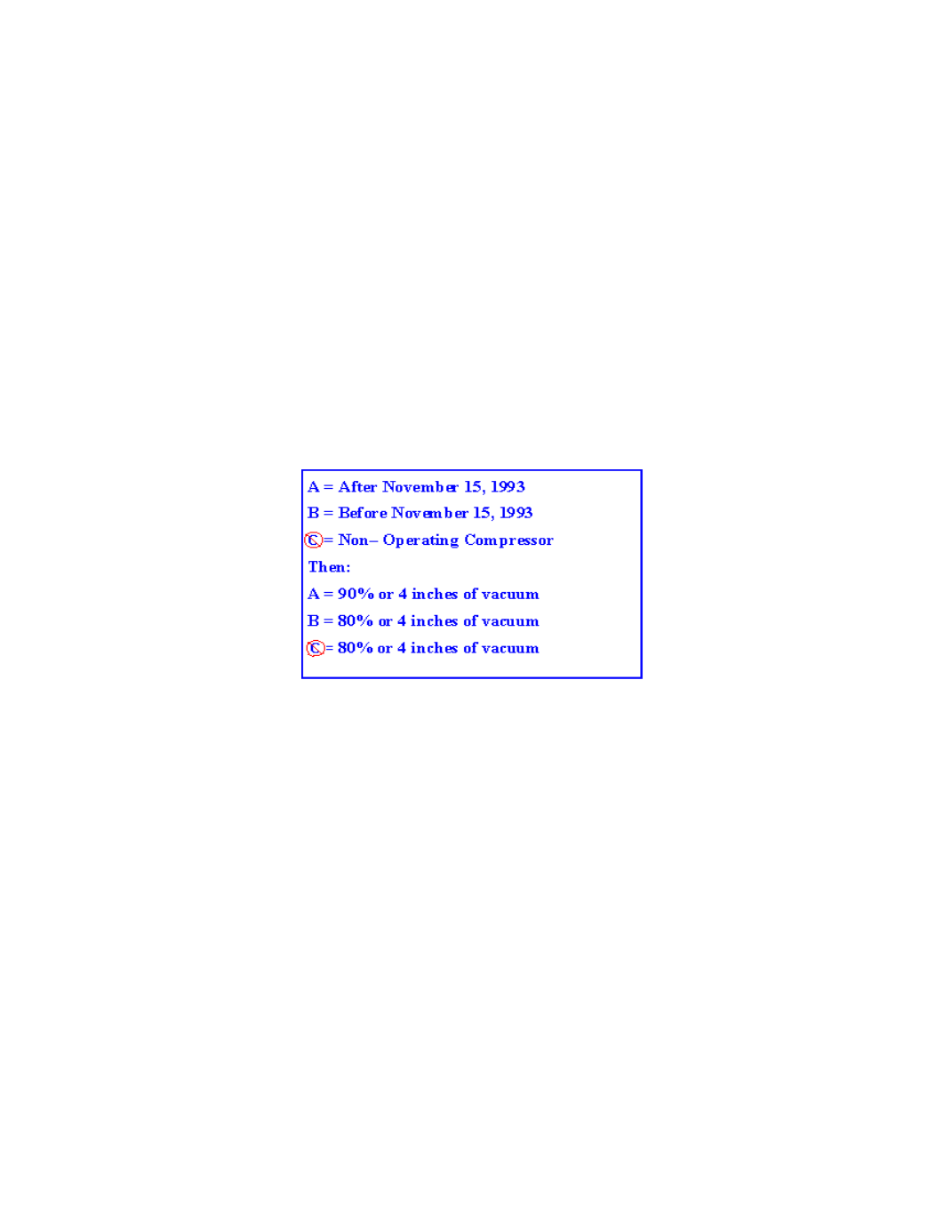
Recovery equipment manufactured before November 15, 1993 must be capable of removing 80% of the refrigerant,
whether or not the compressor is operating, or achieve 4 inch vacuum under the conditions of ARI 740.
Recovery equipment manufactured after November 15, 1993, must be certified by an EPA approved testing labora‐
tory, (example, U.L. or E.T.L) as capable of recovering 90% of the refrigerant if the compressor is operating, 80% of the
refrigerant if the compressor is not operating, or achieving a 4 inch vacuum under the conditions of ARI 740.
All equipment must be equipped with low loss fittings that can be manually closed, or close automatically, when
hoses are disconnected to minimize the refrigerant loss.
The following chart is designed to aid you in memorizing the EPA requirements.
LEAK REPAIR REQUIREMENTS
The EPA does not require leak repair for small appliances, but leaks should be repaired whenever possible.
RECOVERY TECHNIQUES
Before beginning a refrigerant recovery procedure, it is necessary to know the type of refrigerant that is in the sys‐
tem. If a reclamation facility receives a tank of mixed refrigerant, they may refuse to process the refrigerant and re‐
turn it at the owner's expense. They may agree to destroy the refrigerant, but typically a substantial fee is charged.
Do not mix refrigerants in a recovery tank.
Self‐contained (active) recovery equipment has its own means of removing refrigerant from appliances and is capa‐
ble of reaching the required recovery rates whether or not the appliance compressor is operable. Self‐contained re‐
covery equipment stores refrigerant in a pressurized recovery tank. Before operating a self‐contained recovery ma‐
chine, make sure that the tank inlet valve is open, and that the recovery tank does not contain excessive non–
condensables, (air). Obtaining accurate pressure readings of refrigerant inside a recovery cylinder is necessary to detect
excessive non‐condensables. The only way to read refrigerant pressure accurately is at a stable, known temperature.
Air in a refrigeration system will cause higher discharge pressures. Follow the operating instructions supplied by the
recovery equipment manufacturer regarding purging of non‐condensables. All refrigerant recovery equipment
should be checked for oil level and refrigerant leaks on a daily basis.
A system‐dependent (passive) recovery process for small appliances captures refrigerant into a non‐pressurized con‐
tainer. These are special charcoal activated plastic “bag” containers. System‐dependent equipment captures refrig‐
erant with the assistance of the appliance compressor, an external heat source, or a vacuum pump0. A standard vac‐
uum pump can only be used as a recovery device in combination with a non‐pressurized container.
6


